
IELTS Writing Essay Question Types - Learn the different task 2 questions
This page is a detailed look at the different question types and how students often misunderstand the question.
Misunderstanding the task 2 question
This is a very common problem, and perhaps the biggest mistake in IELTS essay writing.
25% of your writing score is assessed on something called ‘task response’. It means the examiners want to see that you understood the question and that you responded accurately and fully to the task in your answer.
It might sound easy, and sometimes understanding the task is very clear and obvious. However, with many of the questions you need to read the question several times to analyse exactly what they are asking you to do. It is very common for students to read the question only once or twice and start writing their essay without analysing the question to be absolutely sure of what they want.
💡Students often get confused with the different parts of the question, so we have highlighted the text so you can clearly understand the difference.
Yellow = Facts Orange = Opinion/s in the question Blue = The task
Yellow = Facts
Orange = Opinion/s in the question
Blue = The task
Question Types
In this section we look at the different question types for the task 2 and provide tips and guidance to help you avoid the common errors we see students make.
🗒️Advantages/Disadvantages Essay
(ℹ️ No opinion needed type)
Have a look at this question:

Yellow = Facts Blue = The task
A logical and clear way to organise this answer would be to have one paragraph describing the advantages of this trend and the other paragraph describing the disadvantages. The essay plan is very clear and can be planned in two columns. Here is the structure:
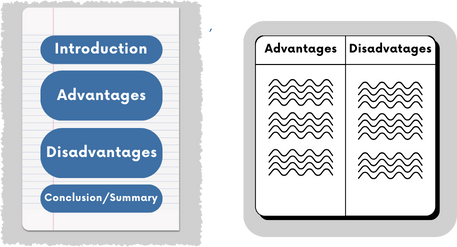
⚠️ A common mistake students make is adding their opinion ( “I believe” or “In my opinion” etc.) when you have not been asked. You would lose marks if you did that with this question. You just need to objectively observe and comment on what the general advantages and disadvantages are, and in the conclusion just summarise what you have said.
🗒️Advantages/Disadvantages Essay (Opinion)
(ℹ️ Your opinion needed type)
Have a look at this similar question:
Nowadays, lots more business meetings take place online. Do you think the advantages of this trend outweigh the disadvantages?
Yellow = Facts Blue = The task
This question looks similar, but it is asking your opinion because it asks you if the advantages outweigh the disadvantages. Therefore, you need to make a clear choice. Of course, it will be easier to come to your own opinion after you have spent some time generating ideas for both sides.

When you look at your ideas, you need to decide if there are more important advantages and weaker disadvantages or there are more important disadvantages and weaker advantages.
Let’s imagine you decide there are more important advantages than disadvantages, then this needs to be represented in your essay structure:

If you thought there were more stronger disadvantages than advantages, then the balance would be reversed:

⚠️ This is a question type where students often lose marks for making the essay balanced and not showing that one side is more important than the other.
✅ Remember when a question asks ‘Do the advantages outweigh the disadvantages?’ They are asking for your opinion about which is more important, the advantages or disadvantages, so you need to show that importance.
✍️Note that ‘Advantages and disadvantages’ might be worded slightly differently like this: ‘Discuss the benefits and drawbacks of this trend.’ or ‘What are the positives and negatives of this trend?’.
🗒️Agree/Disagree Essay
(ℹ️ Your opinion needed)
This type of essay question presents an opinion that you have to agree or disagree with. Here is an example:
Many food and drink products often contain high levels of sugar, which cause many health problems. Sugary products should be made more expensive to encourage people to consume less sugar.
Do you agree or disagree?
Agree/Disagree essay questions could be written in different ways:
- Do you agree?
- To what extent do you agree?
- Do you agree or disagree?
- To what extent do you agree or disagree?
- Do you agree with this point of view _____?
- What is your opinion?
- Do you agree that _____?
- Do you agree with this opinion?
🔍 It is important to realise that they all mean the same thing. They are asking for your opinion and for you to present your opinion.
Should I completely agree or disagree, or partly agree or disagree?
We recommend that you fully agree or disagree because it gives absolute focus to your essay. There is no confusion for you or the examiner in understanding your position and presenting clear arguments for it. Your essay structure would look like this:

⚠️ You can write an essay that partly agrees or disagrees, but this very often leads to an unclear and confused argument or a weak imbalanced essay structure. We do have an example of a well-written partially agree essay on our sample essay page, but again, we don’t recommend this approach and you will not gain any more points by writing a partially agree/disagree essay.
Let’s have a look at the same question but let’s highlight the facts, opinion, and task:

Yellow = Facts
Orange = Opinion/s in the question Blue = The task
⚠️ Students often get confused in ‘Agree/Disagree’ type questions, so it is important to practise identifying the difference between facts and opinion/s in essay questions. The task is asking you to agree or disagree with the opinion stated (that sugary drinks should be made more expensive to encourage people to consume less sugar).
It’s very common to see students making the mistake of agreeing or disagreeing with the background facts and not the opinion in the question which leads to an essay that doesn’t accurately target the question.

Misidentifying what needs to be answered will unfortunately lose you a lot of marks, so it’s very important to practise analysing lots of different questions until it becomes obvious for you.
✍️ Be aware that sometimes there will be no background facts in the question, only an opinion.
🚀 Useful Tip
It is often very helpful to rephrase the opinion in the question to make it more clear to yourself:
Should sugary products be made more expensive to encourage people to consume less sugar?
Review
✅ Analyse the question carefully to Identify the opinion part of the question. This is what you will be agreeing or disagreeing with. You will then be on target and you can be sure you are focusing on what needs to be answered.
✅ Choose one side to argue for and stay with this side.
✅ Rephrasing the opinion in the question can help you have a clearer understanding.

🗒️Discussion essays
(ℹ️ Opinion needed/No opinion needed)
‘Discussion essays’ are identified by two opposing views. You have to discuss both these views, and in most cases, give your opinion. Students often get confused when presenting the views of others with their own opinion. Let’s have a look at an effective approach to this type of question and start by analysing a question:
Some people think that a sense of competition in children should be encouraged.
Others believe that children who are taught to co-operate rather than compete become more useful adults.
Discuss both these views and give your own opinion.
Orange = Opinion/s in the question Blue = The task
When two opinions are presented in the question, we again recommend rephrasing the question to yourself as a question, so you can see from the perspective of others:
▪ Why do some people think that a sense of competition in children should be encouraged?
▪ Why do other people believe children who are taught to co-operate rather than compete become more useful adults?
💡 Your own opinion is much easier to formulate after brainstorming and thinking about relevant ideas. However, many students struggle to know where to put their opinion in this type of essay. There are a few approaches that different IELTS teachers use for ‘discussion essays’, but we find the approach below to be a clear and straightforward structure:
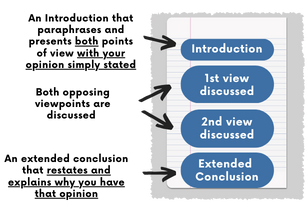
Your opinion is clearly stated in the introduction and then the two different sides are presented with an extended conclusion explaining why you have chosen that opinion.
Non opinion ‘Discussion Essays’
You could be presented with the same question, but it only asks you to discuss both views:


The structure for the main body paragraphs is exactly the same, but do not give any opinion in the introduction or conclusion. Remain objective and just comment and summarise as an observer on the two views presented.
🗒️Double Question Essays
(ℹ️ Your opinion is often needed)
Have a look at this question:

Yellow = Facts Blue = The task
There are two direct questions that need to be answered equally. When analysing this type of question with two task questions you need to be aware that sometimes one, or both task questions may be asking for your opinion.
⚠️ A very common problem is students do not understand if the task questions are asking for your opinion or not.
In the above question, which question do you think is asking for your opinion and which question is asking you just answer objectively (just commenting on the situation as an observer without your opinion)?
Read the question again and think carefully – scroll down when your ready to see the answer.

Answer
▪ The first question is just getting you to answer objectively. Why, generally, do many people prefer to watch big budget films?
▪ The second question ‘Should governments support local film industries?’ is asking you to make a decision, yes or no, which is a personal opinion.
✅ When you give your opinion in any IELTS essay, always be clear with phrases like “In my opinion”, “I believe”, “Personally, I think that”, etc.
Here is the suggested structure for this type of essay:

🔍 It is important to practise identifying which questions are asking for your opinion, or are asking you to just observe and comment on the situation objectively.
🗒️Problem/Solution + Cause/Effect Essays
Have a look at this question:

These type of questions present a problem and then ask for solutions. Hopefully you can see that this essay question is not asking for your opinion.
⚠️The biggest problem with these types of essays is students just list many problems and solutions without developing one or two ideas and relating the solutions to problems.
⬇️ We are going to learn how to generate ideas in the next section.
Structure for this type of essay:

✅ When you give your solutions, try to make sure they relate to the problems in the first paragraph.
Cause and Effect Essays
Look at the same question, but with a difference:

The first part of the question is the same, but they want to know the effect and not the solutions.
▪ A cause = The reason for the problem. Why something happens.
▪ An effect = The result/consequence of a cause.
🔍 Notice this question gives you two areas that you must mention and focus on in the second paragraph of your essay:

Essay Structure:

Section Review
You can see the importance of carefully analysing the question to understand exactly what they want. 25% of your overall writing score is given to ‘task response’, so don’t make the mistake many students make and ‘just start writing’ without analysing and being sure you know exactly what they are asking you.