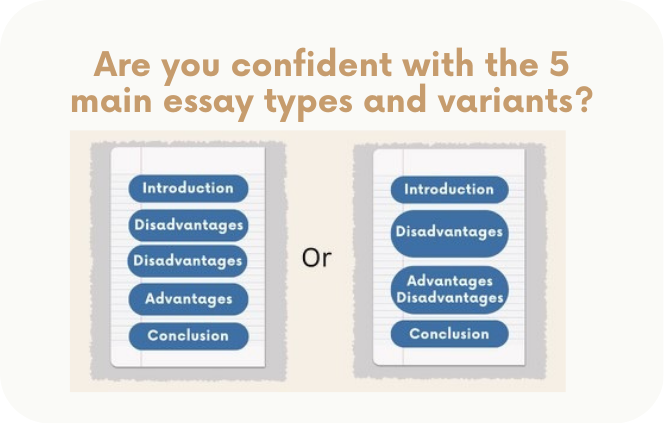
IELTS Writing Essay Question Types – Learn the different task 2 questions
This page is a detailed look at the different question types and how students often misunderstand the question.

This free online band 7 IELTS writing course has exercises and information for students who are struggling to improve their writing band scores.
The writing section of the IELTS test is the most challenging part for many students, and our hope is that this guide will help you to see real improvements.
The IELTS writing test takes 1 hour in total and is divided into two tasks:
You will either be doing the ‘IELTS academic test’ or the ‘IELTS general test’. The task 2 is the same for both tests, but the difference is the task 1.
In our experience, there are three common reasons why students receive a low band score for IELTS writing:
The exercises below are to help students looking to reach band 7.

This page is a detailed look at the different question types and how students often misunderstand the question.
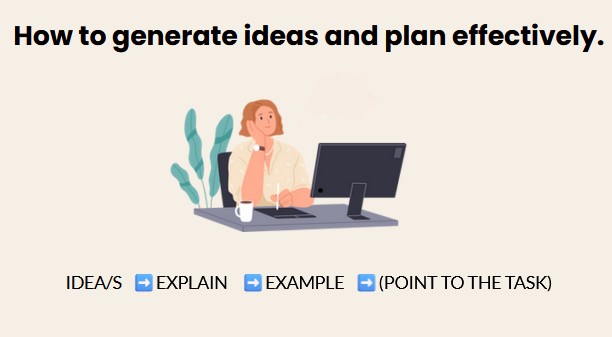
Our next article will show you how to generate ideas, plan a task 2 essay, and make it flow well.

It is important to realise that 50% of the task 2 marks are on how well you respond to the task and how well these ideas flow. Planning is essential! On this page, we will look at different ways to think of ideas, plan an essay, and make them flow and connect well.
The other main reasons students receive a low IELTS writing band score are due to:
We think the exercises in this free course below will help you to improve these areas.
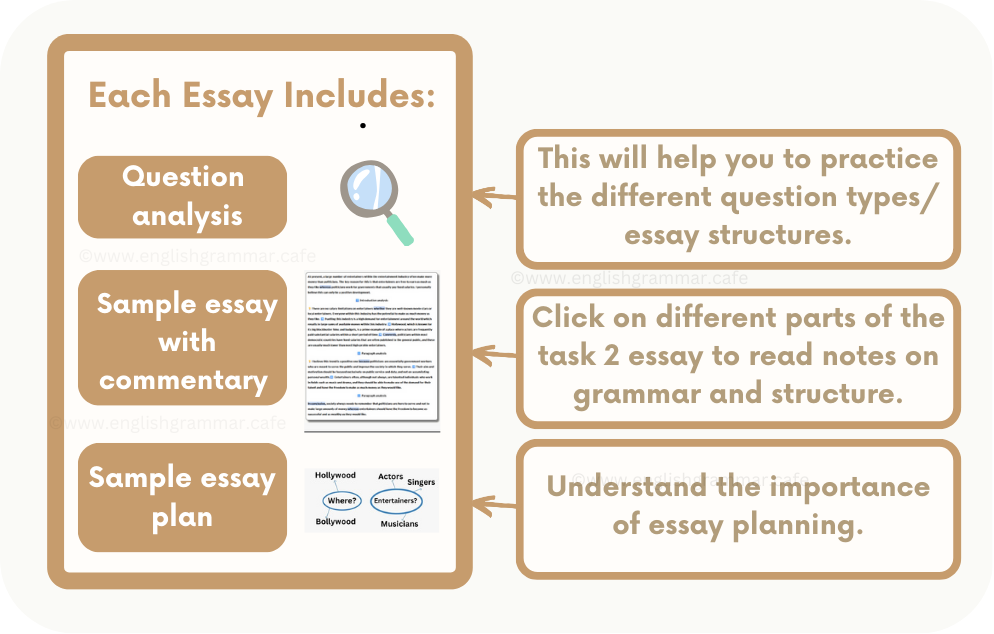
Each essay has a full explanation of the sentence types, types of linking words, common problems, and vocabulary used.

The sample task 2 essays on this page are to help you become aware of ideas, grammatical options, vocabulary, and to show you the importance of planning. Each essay has a question analysis and an example essay plan.
In this exercise, you have to identify mistakes in student’s task 2 essays.
💡 To achieve band 7, you need to focus on minimising your grammatical errors as much as you can. Simplifying your grammar to ensure it is accurate is better than trying to impress the examiner by writing sentences that could contain errors.

In this exercise below, you have to identify the errors in sentences from task 2 essays. These exercises will help you become aware of common mistakes students make within their essays.
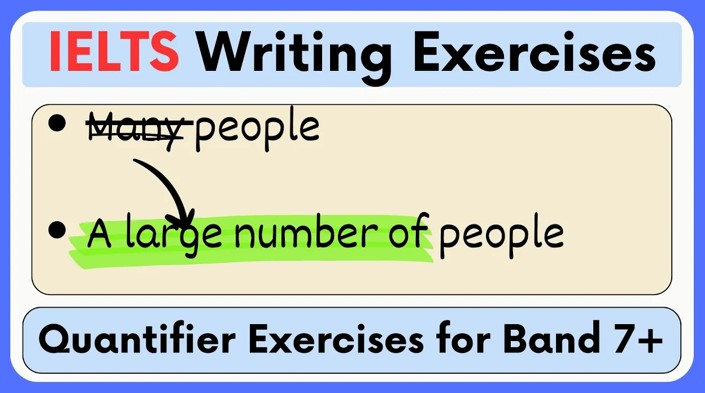
Quantifiers are the words that go before nouns and show the amount or quantity of something. Students often use the same quantifiers ‘many’ and ‘some’ in their writing and speaking. However, if you are aiming for band 7, there are a large number of other quantifiers you should be aware of.
🚀 Many students report an improvement of 0.5 band score just by improving their range of quanitifers in their writing.

If you are aiming for a band score over 6.5, it is good to show the examiner that you know a wider range of quantifiers. The exercises below will help you to become aware of other quantifiers you can use before uncountable and countable nouns.
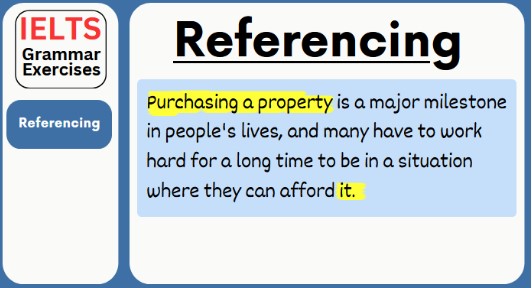
Students often overlook the importance of referencing within an essay. Essays without referencing suffer from repetitiveness which can negatively impact your cohesion and coherence score.

25% of your overall IELTS writing score is graded on ‘Coherence and Cohesion’, which is a large percentage of your overall grade. To score well, your essay has to flow and be easily understood by the examiner. Practice these exercise to understand how to reference in your IELTS essays.
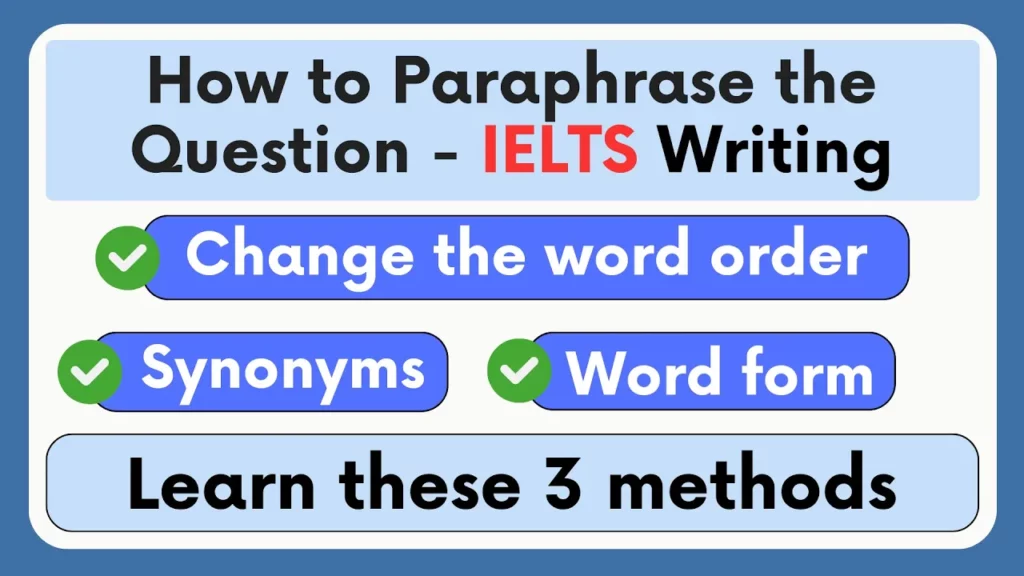
This page will teach you how to write an IELTS task 2 introduction and use paraphrasing effectively. There are practice exercises at the end of the page.

On this page, we will start by looking at how to paraphrase an IELTS task 2 introduction. Many students often lose marks by paraphrasing inappropriately, over paraphrasing, or being unaware of the strength paraphrasing can have on your essay.
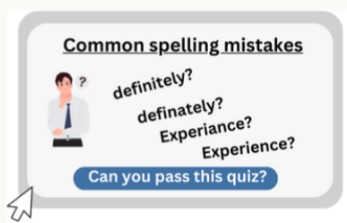
Review the common spelling mistakes students make again and again.

This exercise will help you to check your spelling for the writing section of the IELTS test. These words are commonly misspelt.
These three words are often confused and are also very common in both tasks. Practice these exercises to understand the differences between these 3 words.

These 3 words are commonly misunderstood. Practice these exercises to fully understand the difference.
This exercise will help you to become aware of fractions that you can use to express different proportions of the pie chart.
This website uses cookies so that we can provide you with the best user experience possible. Cookie information is stored in your browser and performs functions such as recognising you when you return to our website and helping our team to understand which sections of the website you find most interesting and useful.
Strictly Necessary Cookie should be enabled at all times so that we can save your preferences for cookie settings.
If you disable this cookie, we will not be able to save your preferences. This means that every time you visit this website you will need to enable or disable cookies again.