
How to generate ideas and plan an IELTS task 2 essay - Easy guide!
Planning an IELTS task 2 essay is essential. It is important to realise that 50% of the task 2 marks are on how well you respond to the task and how well these ideas flow.
On this page, we will look at different ways to think of ideas, how to review and select your most relevant ideas, and create a basic plan of how you will explain and support your argument.
Page Content
After you have understood the question type (click here to understand this important step), you want to allow at least 5 minutes for planning. This might seem like a long time, but it will actually save you time and give you a clear vision and overview of your essay from the start.
It is very easy for students to lose a lot of marks by drifting away from the topic or by having irrelevant ideas. Therefore, a simple and strong essay plan is your answer to this and you will feel much more confident for the remaining 30-35 minutes.
Let’s have a look at a task 2 question and learn some techniques.
How to generate ideas for unfamiliar task 2 topics
Method 1: Make things real!
Read the task 2 question below. This is a ’cause and solution’ question.
In city centres, there is often too much noise in public places.
What are the causes of this, and what can be done to solve the problem?
👍 Hopefully you can understand that this question is not asking for your opinion, and just wants you to remain objective and comment on the situation as an observer.
🔄 Read the question again and think about the first part of the task (the causes). In your mind, imagine a city centre that you know or you have seen in movies. Try to visualise the situation and ask yourself questions:
“Why is it noisy?”.

Take a moment to make this situation very real to yourself – Think of a city you know.
Click below to see some possible ideas
 Traffic / People / Construction sites / Noisy aircraft /Specific places
🔍When you read the question, make sure you notice any specific keywords used in the question. This question mentions “public places”.
Public places could include a wide variety of areas such as streets, walkways, parks, and even places like libraries and other public areas.
💡When you feel confident that you have relevant ideas, you can move on to create a simple plan to organise and develop your ideas.
How to plan and develop your essay ideas to make them flow
Have a look at this very simple, yet effective way to make your ideas flow:
There are a few variations to this method which will be explained below. The most important thing is to make the presentation of your idea/s as simple as possible for the examiner to read.
If you use this method, your ideas will remain connected and will flow logically and clearly. It will stop you from drifting and losing focus of the task, which is one of the most common errors students make!
An idea flow plan for the causes
IDEA = Lots of noisy vehicles EXPLAIN ➡️ Too many people commuting by cars and buses (at peak hours) /Construction sites (machines) EXAMPLE ➡️ Cities doing lots of inner city building/development hear these machines the most. ✅ Good idea and development
IDEA = Aircraft noise (Possible idea, but many cities have airports far away from the centre).
IDEA = Factories can create a lot of noise ❌ (An unsuitable idea because factories are usually on the outside of cities and not in city centres).
⚠️ Be very aware when generating your ideas that some of your ideas might not be relevant to the task, or some ideas might be less relevant than other ideas . This is why it is essential to be very selective.
🔍 It is good to re-read the question, and then look at your ideas again. You want to feel very confident your ideas are on target.
✅ Notice that the above ideas are not complex and confusing, but are simple and quite obvious. Many students often make the mistake of thinking the IELTS examiners are looking for very complex and sophisticated ideas, but they are not. They are looking for ideas that simply answer the question and then are developed and explained well.
Here is the plan for the second part of the question: What can be done to solve this problem?
Plan for the solutions
IDEA = City councils/planners could introduce restrictions >>to deter traffic >>lower noise. EXPLAIN ➡️ Restrict non-essential traffic / Low speed limits / Trucks only at night. EXAMPLE ➡️ Inner London has a low 20 mph limit + inner city congestion charge (effective at limiting traffic/noise).
✅ A simple idea that has been well developed and explained.
ℹ️ We only focused on thinking of solutions to the causes we have already chosen. This makes everything link and flow together which will help improve your coherency and cohesion score.
The full essay
Have a look at the full essay on noise in city centres. It follows the plan we created:


In the centre of most cities, you can find excessive noise in public places such as streets and parks. While there are many causes of this noise, vehicles and construction sites are often the loudest noise makers in inner urban areas. Reducing noise within a city centre is not easy although there are some restrictions city councils could introduce.
Large numbers of road vehicles and noisy construction sites are commonly heard in most inner cities. People use cars and buses to commute to work in inner cities, and commercial vehicles, which usually make louder noise, to deliver goods within a city centre. These vehicles frequently create excessive engine and horn noise, especially during busy times of the day. In addition to vehicle noise, construction sites within inner cities are also prime causes of noise in public places due to loud drills and other noisy machinery. Cities that are undergoing lots of inner residential or business development are good examples of places that can suffer from this type of noise in public places.
Possible solutions to reducing noise could come from city councils that have the power to introduce restrictions. Non-essential driving in city centres could be significantly restricted to only allow residents and necessary delivery vehicles in. Furthermore, if cities introduced lower speed limits throughout centres and restricted trucks to only deliver at night, noise could be realistically lowered. London, for example, has implemented a very low 20 miles per hour speed limit across most of the inner city as well as having a congestion charge which seems quite effective at deterring excess traffic and related noise.
In conclusion, the problem of noise within a city is unlikely ever to be fully solved. However, speed limits and specific vehicle restrictions at certain times do have the potential to lower noise in a city centre if implemented well.
Notice how everything flows and is connected making it very easy to read and understand.
ℹ️ It is often very effective to include a sentence at the end of a paragraph that points back to the question task. This can help ‘glue’ the paragraph and shows the result of what you have been explaining.
🚀 This really helps you improve your cohesion and coherance score.
Examples are very effective, but you don’t always need to include one
Have a look at the same first main body paragraph below that does not include any specific example and just points back to the task :
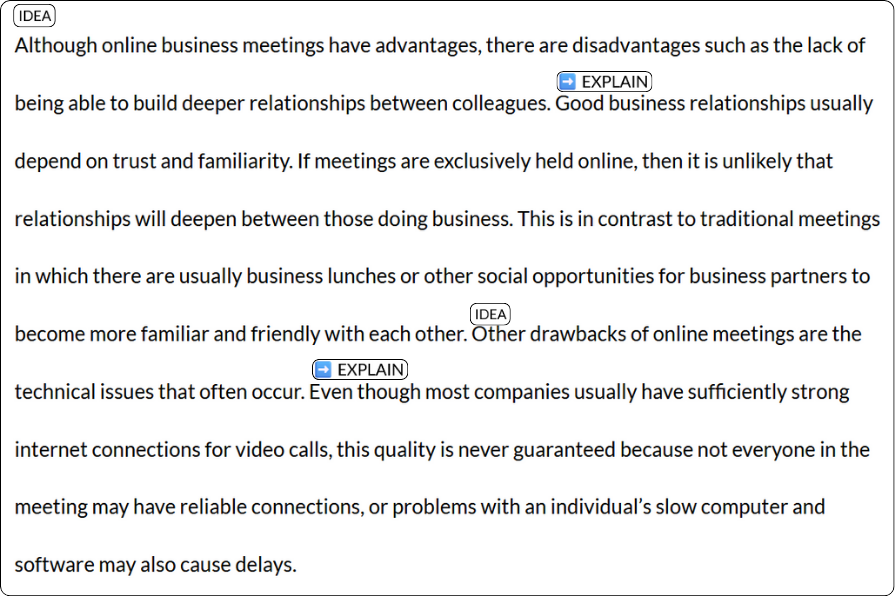
IDEAS ➡️EXPLAIN ➡️EXPLAIN ➡️POINT TO THE TASK

Some task 2 questions types require a slightly different approach:


This format is very useful in IELTS ‘Advantage’/’Disadvantage’ essays.
Review
When you first begin to practise planning, we recommend spending as much time as you need. As you get more confident you will get quicker and find your own style.
🎓
After reading this guide, have a look at our ‘Task 2 sample essays for IELTS writing‘ page to see a selection of IELTS essays with plans that you can practise.
Method 2: The 'Ask Why?' Method
If you have an ‘Opinion’ and ‘Discussion’ essay, this is a very simple and effective method for generating ideas. You simply rephrase the question to yourself.

⬇️Rephrased version⬇️

‘Discussion’ essay question:

⬇️Rephrased version⬇️
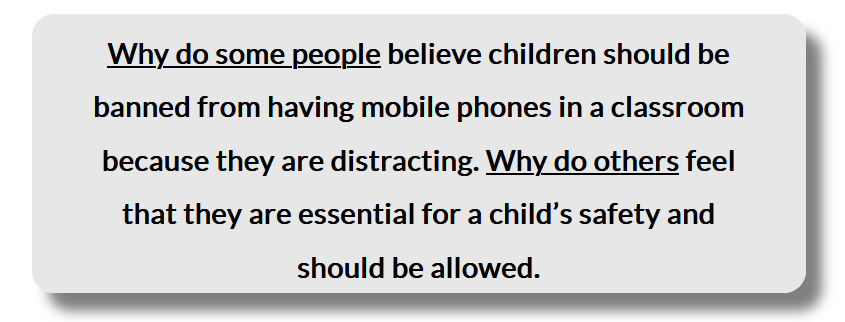
✅ Different viewpoints emerge which will help you generate relevant ideas.
🚀 Tip
✅ Thinking about what your friends and family might say also really helps to get different perspectives.
Method 3: Preparation before your IELTS exam - The best method! 🚀
This is last on our list because many students do not prepare at all and may even have their exams tomorrow. However, preparing many weeks/months before your exam is the key to success and the most important approach to having lots of ideas for your writing test on exam day.
Becoming familiar with common topics and questions that appear in the task 2 will make your planning speed become significantly faster, and you will not waste time trying to think of ideas on the day of your test.
We recommended:
✅ Creating lots of essay plans for different task 2 questions (you don’t need to write full essays).
✅ Practise writing full task 2 essays and then get feedback on them.
✅ Read good model essays. (click here)
✅ Become familiar with relevant vocabulary for each topic.
✅ Read news articles – Especially for topics that are unfamiliar to you.
This preparation will also help you with the other areas of the IELTS test. 💪